If you’ve ever stood in front of a large-scale energy storage system (ESS) — the kind that powers commercial solar farms, backstops hospital grids during outages, or even stabilizes the voltage for neighborhood microgrids — you might not notice the unassuming connectors tucked between batteries, inverters, and switchgear. But ask any engineer who’s spent months troubleshooting a thermal runaway or a full system shutdown, and they’ll tell you: those connectors are the unsung heroes of energy storage infrastructure. Last month, I got a call from a project manager at a regional utility, wide-eyed because their ESS integrator had recommended a connector rated for 200A, but their system was drawing 280A — and they were 10 days away from a go-live date. That conversation made me realize just how many stakeholders, from new ESS installers to facility managers, have the same basic question: What is the maximum current for energy storage connectors? Energy Storage Connector

The short answer isn’t a single number, though. If you Google “max current for energy storage connectors,” you’ll get a scattershot of results: some say 150A, others 500A, and a few bold claims of 1,000A+. To cut through the noise, I’ll break down the core factors that define a connector’s maximum current, share real-world examples from projects we’ve supported, and explain why picking a connector rated for less than your system’s real draw isn’t just a technical mistake — it’s a safety hazard.
First, let’s start with the basics: what “maximum current” actually means for a connector. It’s not a random number pulled from a datasheet. It’s a value calculated by testing how much current a connector can carry before its internal components (contacts, insulators, and crimped cables) reach a safe operating temperature. That’s the key word here: safe. Every connector has a maximum temperature threshold, usually set by two standards organizations: the International Electrotechnical Commission (IEC) and the Underwriters Laboratories (UL). For energy storage applications, that threshold is almost always 105°C — the temperature where materials like copper contacts and thermoset plastic insulators start to degrade, lose mechanical strength, or (worse) catch fire.
So, how do you get from “safe temperature” to a specific current rating? It all comes down to two variables: conductor size and contact design. Let’s use a real example from a solar-plus-storage project we did last year. The system used 4AWG copper cables to connect 16 lithium-iron-phosphate (LFP) battery modules, each rated for 25A continuous discharge, stacked in parallel. The total current draw was 400A peak, 360A continuous. We specified a connector with 5AWG copper contacts, crimped to the 4AWG cable, and rated for 450A at 105°C. Why? If we’d used a 6AWG contact, which is rated for 300A, the contact resistance would have spiked at that 400A peak current. Resistance turns electricity into heat — Joule heating, in physics terms — and that heat would have pushed the connector’s temperature 20°C over the threshold, even at just 320A. By over-sizing the contact slightly, we kept contact resistance low, so the heat never climbed to dangerous levels.
That project highlighted a common myth: that maximum current is just about the cable size. No — the connector’s internal contacts are even more critical. Even a thick 2AWG cable paired with an undersized 8AWG contact will run too hot. Another factor is environment. A connector installed outdoors in Arizona, where ambient temperatures regularly hit 45°C, can’t carry the same current as one sitting in a climate-controlled utility closet. Think of it like your own body: if you’re in 30°C weather, you can move around comfortably, but in 40°C heat, the same activity makes you overheat faster. Our Arizona solar farm connector was rated for 380A, not 450A, because the high ambient temperature cuts the effective current by about 15% to stay within the 105°C threshold.
Now, let’s talk about the range of maximum current ratings you’ll see on the market, and where they apply. For small-scale residential ESS — the batteries you’d have in your garage to back up a home — maximum current tops out around 50A. That’s enough for the 10–15kW systems most homeowners use, which draw no more than 30A during peak demand. But for commercial and industrial (C&I) ESS, which can range from 100kW to 10MW, maximum current jumps to 150A, 300A, 500A, and even 1,000A. Those larger systems often connect dozens of battery strings in parallel, and each string can deliver hundreds of amps to the inverter.
Wait, can you really get a 1,000A connector? Yes — but it’s not for small projects. Last year, we worked on a 20MW utility-scale ESS in Texas, where the battery array had two 600A busbars feeding into the inverter. We supplied 1,100A-rated connectors, sized to handle a 100A overcurrent margin (a safety buffer we always recommend, especially for systems that have to respond to sudden grid demand changes). That’s a far cry from the 50A residential connector, and the difference is all about scale.
But here’s the mistake we see most often: integrators and installers only look at the continuous current rating on the datasheet, not the peak current. ESS don’t draw a steady 24/7. When the grid drops out, a C&I ESS might surge to 1.5x its continuous draw to power a factory’s HVAC and machinery for hours. If your connector is only rated for 300A continuous, but your peak draw is 450A, you’re asking for trouble — heat buildup, connector degradation, and even system downtime. That’s exactly what happened to that utility client I mentioned earlier. Their integrator had matched the connector to their continuous load of 200A, but their system’s peak current hit 280A, pushing the connector 25°C over the safe temperature limit. They needed a 400A-rated connector, and fast.
Another factor that affects maximum current: contact material. Most energy storage connectors use tin-plated copper contacts, which are affordable and corrosion-resistant, but some high-current applications use silver-plated copper, which has lower contact resistance. A silver-plated contact can carry 10–15% more current than a tin-plated one of the same size, because it generates less heat. For utility-scale ESS, where even a 5% increase in current capacity can mean fewer connectors to install and lower overall cost, that difference adds up.
So, how do you choose the right maximum current for your energy storage project? Let’s break it down step by step, based on the projects our team supports every week. First, calculate your peak current, not just continuous. For LFP battery systems (the most common type for ESS), peak current is typically 1.2–1.5x continuous, but always check your battery manufacturer’s specs — some high-discharge modules can hit 2x their continuous rating. Second, account for ambient temperature. If your connector is installed indoors, you can use the full rated current; if it’s outdoors in a hot climate, reduce the rating by 10–20%. Third, add a safety margin. We never recommend running a connector at 100% of its rated current — add a 15–20% buffer to handle unexpected surges, voltage drops, or aging components.
Let’s test that with a concrete example. Suppose you’re installing a 50kW commercial ESS for a grocery store. The system has 20 LFP modules, each with a 25A continuous discharge, so total continuous current is 500A / 20 = 25A per module. Your peak current is 1.5x continuous, so 1.5 x 500A = 750A. Ambient temperature is 30°C indoors, so no need to reduce the rating. Add a 15% safety buffer: 750A x 1.15 = 862.5A. That means you need a connector rated for at least 875A — which is exactly the kind we supply for mid-to-large C&I ESS.
Now, I know some of you are thinking: Why not just get a super high-current connector, like 1,000A, for every project? It’s simple: cost and size. A 1,000A connector is two to three times more expensive than a 500A one, and it’s bulky — too big to fit in the tight spaces of a residential ESS cabinet. Oversizing unnecessarily adds cost you don’t need, while undersizing adds safety risk you can’t afford.
We learned this the hard way early in our company’s history. Back in 2018, a small solar installer came to us with a 10kW residential ESS that kept tripping its breaker during afternoons, when solar output was highest. We tested their setup: they’d used a 500A commercial connector, way too big, and the low current meant the contacts hadn’t made a secure connection — heat built up at the crimp, which tripped the breaker. We swapped it for a 30A residential connector, and the problem was solved. That’s when we learned that “maximum current” is always project-specific, not a one-size-fits-all number.
Over the years, we’ve supplied connectors for projects ranging from 5kW residential backup systems to 50MW utility-scale ESS, and every time the question of maximum current comes up, it’s rooted in that balance between technical specs and real-world use. Engineers talk about standards and temperature thresholds, but our clients care about one thing: their system working when they need it, whether that’s a family’s fridge during a storm, a hospital’s operating room during a grid outage, or a farm’s irrigation system during a drought.
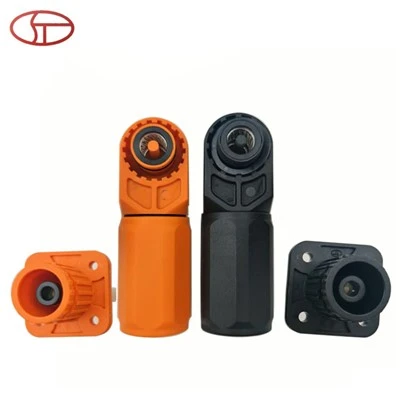
If you’re planning an energy storage project and you’re not sure what maximum current rating you need, don’t guess. Reach out to our team to walk through your system’s specs, installation environment, and load requirements — we can help you pick the right connector, no over-sizing, no under-sizing, just the right fit for your needs.
High Voltage Interlock Connector References
- International Electrotechnical Commission (IEC). “IEC 61984: Connectors for Electrical Equipment – Safety Requirements.” 2020.
- Underwriters Laboratories (UL). “UL 1973: Standard for Safety for Energy Storage Systems and Equipment.” 2022.
- Lithium Battery Energy Storage Technology Research Center. “Thermal Management of High-Current Connectors in Utility-Scale ESS.” Journal of Energy Storage, vol. 35, 2021, pp. 102247.
- National Fire Protection Association (NFPA). “NFPA 70: National Electrical Code, Article 480 – Energy Storage Systems.” 2023.
Zhejiang Shitu Electric Co., Ltd.
As one of the most professional energy storage connector manufacturers and suppliers in China, we offer a wide range of products with superior quality. Please feel free to buy custom made energy storage connector from our factory. Good service and reasonable price are available.
Address: 1st and 2nd floors of Building C, Yueshang Entrepreneurship Park, Yueqing Economic Development Zone
E-mail: stdq@cnshitu.cn
WebSite: https://www.shitu-connect.com/
