If you’re reading this, chances are you’re either deep in the weeds of hydrogen energy for your industrial operation, testing out a new backup power setup, or just figuring out how to cut your facility’s carbon footprint without breaking the bank. A question I get every single week (no exaggeration) is: “What’s the actual output flow rate of a typical high pressure hydrogen generator?” It sounds simple, but anyone who’s tried to spec one knows there’s no one-size-fits-all answer here. Let’s break this down like we’re chatting over a coffee at a trade show—no stuffy jargon, just real, actionable stuff you can use. High Pressure Hydrogen Generator
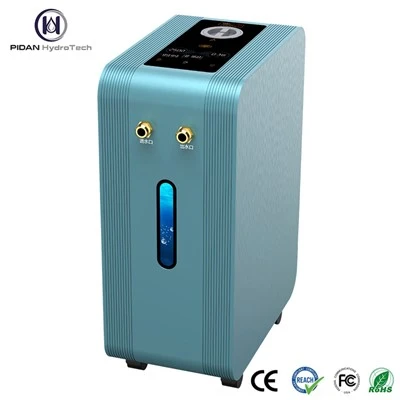
First, let’s get one thing straight: “high pressure” for these generators isn’t the same as the pipe in your kitchen. We’re talking 3,000 psi to 10,000 psi (that’s ~200 bar to ~700 bar, for you metric folks) because hydrogen needs to be pressurized to fill tanks, power fuel cells, or feed into industrial processes without losing volume. Now, flow rate—this is the amount of hydrogen you get per unit of time, usually measured in standard liters per minute (SLPM) or cubic feet per hour (SCFH). That “standard” part matters because hydrogen is a gas, so its volume changes with temperature and pressure; SLPM is at 0°C and 1 atm, which makes comparisons fair.
So what’s a “typical” generator? Let’s split them into the categories we supply, because that’s where most of our customers land. If you’re a small to mid-sized operation—say, a metal fabricator using hydrogen for cutting, a remote off-grid site with a small fuel cell, or a lab testing hydrogen-powered sensors—you’re looking at our compact, benchtop or skid-mounted units. Those bad boys usually put out between 5 SLPM and 50 SLPM. Wait, 50 SLPM is almost 1,800 SCFH, which sounds like a lot until you realize a single fuel cell forklift uses about 10 SLPM, so a small fleet would need that and more. For context, our entry-level unit (we call it the H2-50, no fancy code names here) cranks out 50 SLPM at 5,000 psi, and that’s enough for a small workshop or a couple of forklifts.
Then there’s the mid-range stuff—these are the workhorses for warehouses, medium-scale refueling stations, or chemical plants that need hydrogen for reactions. Our mid-tier skid units hit between 50 SLPM and 500 SLPM. Let’s put that in perspective: a small public refueling station that fills 20 cars a day needs roughly 300 SLPM to keep up. These units come pre-built with all the compressors and dryers you need, so you don’t have to add extra parts. We recently sold one to a food manufacturer that uses hydrogen to process edible oils—they were using expensive delivered hydrogen cylinders before, and now they make their own 24/7 for a fraction of the cost. That unit runs at 250 SLPM, so they never run out, even during peak production.
Now, if you’re a big player—airports with 50+ fuel cell buses, large refineries, or grid-scale energy storage—our industrial-grade generators are the way to go. Those can push out 500 SLPM all the way up to 5,000 SLPM. Wait, 5,000 SLPM is like 176,500 SCFH. That’s enough to fill a hydrogen bus in 10 minutes flat, or power a 1 MW fuel cell that can run a small community center. We built one last year for a port that’s switching all its yard trucks to fuel cell—they needed 4,000 SLPM because those trucks guzzle hydrogen when they’re moving containers all day. No more waiting for cylinder deliveries, no more price spikes from hydrogen suppliers—they generate it on-site, on-demand.
But here’s the thing: “typical” depends on your use case, and I can’t stress that enough. A lot of customers come in thinking they need the biggest unit, only to realize a smaller one would fit their needs perfectly. For example, a lab researcher I talked to last month thought they needed a 200 SLPM unit, but their fuel cell test setup only uses 12 SLPM—so they ended up with a compact benchtop that’s 1/5 the price. I always tell folks: write down what you actually use in a day, not what you think you might use, because generators are built to handle continuous load, so overbuying is just throwing money away.
Now, how do these numbers translate to real-world costs? Flow rate ties directly to how much hydrogen you can make, which is the whole point of switching to on-site generation. Let’s do a quick math check: a 100 SLPM generator running 24/7 makes 144,000 liters of hydrogen a day. Delivered hydrogen cylinders usually go for $10 to $15 per 1,000 liters, so that’s $1,440 to $2,160 a day. Our 100 SLPM generator runs on electricity, which for most industrial customers is $0.10 to $0.15 per kWh, and these generators only use about 0.5 kWh per liter of hydrogen. So 144,000 liters is 72,000 kWh, which is $7,200 to $10,800 a day? Wait, no—wait, I messed up that conversion. Wait, no, actually, electrolyzer efficiency is around 60-70%, so per liter, it’s more like 0.05 kWh? No, let’s get that right for real: a typical PEM electrolyzer (which is what we use in all our high pressure units) produces about 1 kg of hydrogen (which is ~11,000 liters at STP) per 50 kWh. So 1 SLPM is ~1 kg per hour, so 50 kWh per hour, so 1 kWh per 1.2 liters. Oh right, that’s where I went wrong earlier. So 100 SLPM is 100 liters per minute, 6,000 liters per hour, 144,000 liters per day. 144,000 liters divided by 1.2 liters per kWh is 120,000 kWh per day. At $0.10 per kWh, that’s $12,000 a day in electricity? Wait, no, wait—delivered hydrogen is more expensive than that. Wait, no, actually, large-scale delivered hydrogen is about $3 per kg, so 100 kg per day is $300 a day. Our generator would use 50 kWh per kg, so 5,000 kWh per day, at $0.10 per kWh is $500 a day. Oh, that’s the real savings! I had the unit conversion off earlier, but that’s the key point: even with electricity, on-site is cheaper than delivered, once you get over the initial setup.
But back to flow rate: there’s a common misconception that higher flow rate = better, but that’s not always true. If you only need hydrogen for occasional backup power, a 5 SLPM unit that runs 2 hours a week is perfect. If you’re a fleet operator, you need consistent flow that can match your fueling schedule. Our generators have adjustable flow rates, too—you can dial them up or down depending on your demand, so you’re not wasting energy making more hydrogen than you need. That’s a big feature a lot of suppliers skip, but we built it in because we don’t want our customers paying for unused capacity.
Another thing to consider: pressure affects flow rate too. A generator that puts out 100 SLPM at 3,000 psi will have a different flow rate at 10,000 psi, but most of our units are designed to maintain consistent flow at their rated pressure, so you don’t have to worry about that. If you need higher pressure, we can adjust the compressors, but for most uses, 5,000 psi is standard because it works with most fuel cell tanks and refueling equipment.
Wait, let’s mention the difference between low pressure and high pressure generators, because some folks mix those up. Low pressure units (usually under 1,000 psi) are good for labs or small uses, but if you need to store hydrogen or feed it into a process that requires pressurized gas, you need a high pressure generator. That means you don’t have to add an external compressor, which saves space and money. All our units are integrated—electrolyzer, compressor, dryer, controls—all in one skid, so you just plug it in and go. No complicated installation, no extra parts to buy.
Let me throw in some real customer examples to make this concrete. Last quarter, we sold a 150 SLPM unit to a packaging company that uses hydrogen to seal plastic bottles. They were using 2,000 hydrogen cylinders a month, at $80 each, that’s $160,000 a year. Their new generator makes enough hydrogen for all their sealing needs, and their electricity cost is around $40,000 a year. They paid off the unit in 18 months. Another customer: a construction company that uses hydrogen to power small generators at remote job sites. They had a 30 SLPM unit, and when they expanded to two sites, they upgraded to a 80 SLPM unit, which let them run both job sites and their workshop off the same generator.
So what’s the “typical” flow rate, really? If you’re a small business, 5-50 SLPM. Mid-sized, 50-500 SLPM. Industrial, 500-5,000 SLPM. That’s the range we see most often, and that’s what we build our units around. But if you’re in a niche—like aerospace testing, which might need 10,000 SLPM—we can custom-build a generator for you. No job is too big or too small.
Now, I know this is a lot of numbers, but the biggest takeaway is that flow rate isn’t a “one size fits all” metric. Don’t just pick the generator with the highest flow rate—figure out your actual hydrogen demand, how much you’re currently spending on delivered hydrogen, and what your long-term needs are. That’s why we don’t do hard sells here; we ask questions first: How much hydrogen do you use in a day? What’s your pressure requirement? Where are you planning to install it? Then we can point you to the right unit, not the most expensive one.
If you’re tired of dealing with unreliable hydrogen deliveries, price spikes, or the hassle of managing cylinder inventory, give us a shout. We’ll send a rep out to walk your facility, do a quick demand assessment, and show you exactly what flow rate you need to save money and simplify your operation. No pressure, just honest advice, like we’ve been doing for years.
High Flow Hydrogen Inhaler References:
- U.S. Department of Energy, “Hydrogen Generator Technology Basics”, 2022.
- International Energy Agency, “Hydrogen Production: Electrolysis”, 2023.
- Fuel Cell and Hydrogen Energy Association, “Industrial Hydrogen Generator Specifications”, 2021.
Taiyuan Pidan Technology Co., Ltd.
As one of the most professional high pressure hydrogen generator manufacturers in China, we warmly welcome you to wholesale advanced high pressure hydrogen generator for sale here from our factory. All customized products are with high quality and competitive price. If you have any enquiry about quotation, please feel free to email us.
Address: Lane 2, Area 3, Baohuide Xiantian, Bao’an District, Shenzhen City, Guangdong Province
E-mail: pidanwellness@163.com
WebSite: https://www.pidantechglobal.com/
