As a refrigerated air dryer supplier, I get this question all the time—usually from guys on the shop floor or maintenance managers who are cutting costs wherever they can. They look at two pieces of equipment: a refrigerated air dryer (their current setup, already installed and paid for) and a nitrogen generator (a needed upgrade for packaging, metal fabrication, or chemical processing). Their first thought is obvious: can I skip buying a whole new nitrogen system just by hooking it up to the dryer I already have? Refrigerated Air Dryer
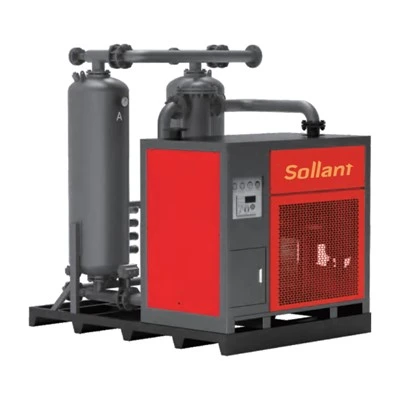
Let’s break this down straight, no fluff, no sales pitches disguised as tech talk. I’ve spent 12 years around these dryers, troubleshooting, installing, and answering exactly this question. It’s not a yes or no answer—it’s a “it depends on what you need” situation. Let’s start with the basics, because too many people skip that part.
First, what does a refrigerated air dryer do? Its whole job is to remove moisture from compressed air. Compressed air from a compressor is full of water vapor, oil, and tiny solid particles. A refrigerated dryer cools that air to around 35 to 40 degrees Fahrenheit, right at its pressure dew point. That’s the temperature where water vapor condenses into liquid, which the dryer traps and drains away. It gets rid of most liquid water, cuts moisture content to around 100 mg per cubic meter of air, and filters out most oil and particles too. That works great for painting, pneumatic tools, even basic electronics assembly.
Nitrogen generation, most commonly membrane or pressure swing adsorption (PSA) systems, works differently. They separate nitrogen from the other 78% of air we breathe, leaving oxygen, argon, and other trace gases behind. For most industrial uses, nitrogen needs to be 95% to 99.9% pure. For food packaging, it’s often 99.5% pure; for metal welding, it can be 99.99% pure.
Now, here’s where the connection comes in. Both systems use compressed air as their feedstock. So logically, your existing refrigerated dryer is treating that compressed air before it gets to the nitrogen generator. But that doesn’t mean the dryer alone is enough to make nitrogen that meets your needs. Let’s get into the gaps, because that’s what trips people up.
The biggest problem is moisture and purity. A refrigerated dryer only gets the air down to a pressure dew point of around 35°F, which is about 100 mg/m³ of moisture. But a nitrogen generator needs feed air that’s almost completely dry. If there’s too much moisture in the feed, two bad things happen. First, the moisture can freeze inside the nitrogen generator’s filters or membrane (if it’s a membrane system) causing blockages, or get into the final nitrogen product, ruining whatever you’re using it for. For example, if you’re packaging potato chips with nitrogen, even a tiny bit of leftover moisture can make the chips go stale. For welding, moisture can cause porosity in the weld, making it weak and fail.
Second, a refrigerated dryer doesn’t remove enough of the other contaminants in compressed air—specifically oil vapor. Rotary screw compressors (the most common industrial type) pump out oil vapor that’s hard to get rid of. A basic refrigerated dryer only removes liquid oil, not vapor. That oil vapor will coat the nitrogen generator’s membrane or PSA adsorbent material over time, clogging it up. Once that happens, your nitrogen purity drops, your production efficiency falls, and you’re replacing parts way sooner than you should. I’ve seen this firsthand at a job site in Detroit: a small auto parts shop tried to use their old refrigerated dryer for nitrogen for their metal stamping line. Within six months, their membrane was completely coated with oil vapor, and they were replacing it twice as often as the manufacturer recommended. That ended up costing them more than if they’d just bought a proper filtration system from the start.
Wait, but hold on—this doesn’t mean it’s impossible. There are cases where a refrigerated air dryer can be part of the setup for nitrogen generation, or even work for low-purity, low-stakes applications. Let’s talk about those edge cases. If your nitrogen needs are pretty basic, like for purging a storage tank that doesn’t need super high purity, or inflating tires on heavy machinery, a refrigerated dryer can work if you add a few cheap upgrades. Most of the time, that means installing a coalescing filter after the dryer to catch any leftover liquid oil and particles, and then an adsorption dryer (specifically a desiccant dryer) downstream of that. Wait, no—wait, a desiccant dryer is different. A desiccant dryer uses materials like silica gel or molecular sieve to pull even more moisture out of air, down to a pressure dew point of -40°F or lower, which is what nitrogen generators need. So if you already have a refrigerated dryer, adding that desiccant dryer and a couple of filters makes your feed air good enough for most nitrogen uses.
But what if someone says, “I don’t want to buy another dryer—can I just run the nitrogen generator right off my refrigerated dryer?” Only if your nitrogen needs are really low. Let’s do a quick math check to make it concrete. A refrigerated dryer at 100 PSI gives a dew point of around 35°F, moisture content about 0.0018 pounds per 100 cubic feet of air. A nitrogen generator for food packaging needs moisture content less than 0.0001 pounds per 100 cubic feet. That’s 18 times drier. The refrigerated dryer alone can’t get there. Another angle: purity. A basic nitrogen membrane needs feed air that’s less than 5 ppm of oil, most refrigerated dryers leave around 10 ppm of oil vapor, which is over the limit. So even if the moisture worked, the oil would kill the system.
I also get a lot of questions about “standalone” nitrogen generators that use just a refrigerated dryer. Let me set the record straight: you won’t find any reputable membrane or PSA nitrogen generator manufacturer that sells a system that works with only a refrigerated dryer. I’ve looked at dozens of spec sheets. The minimum feed requirements for any nitrogen system I’ve ever seen include a pressure dew point of -40°F or lower, and oil content less than 0.5 ppm. That’s why all commercial systems have a desiccant dryer and multiple filters built in, not just a refrigerated one.
Wait, but why do people keep asking this? Cost is the big one. A refrigerated dryer is already there, so why spend $5,000 to $10,000 on a whole new system when you think you can repurpose what you have? I get that. But here’s the cost trap I see all the time. If you try to run nitrogen off a refrigerated dryer alone, you’ll get lower productivity, more downtime, and higher maintenance costs. Let’s use that auto parts shop example I mentioned earlier. They saved $6,000 by skipping the desiccant dryer, but their membrane failed after 7 months, and replacing it cost $3,500, plus they had to shut down production for two days to swap it out. That cost them $12,000 in lost production and parts, which is way more than the $2,000 they would have spent on a small desiccant dryer to go with their existing unit.
There is one niche where a refrigerated dryer actually does work as the sole dryer for nitrogen generation. If you’re generating nitrogen on a very small scale—like for a small laboratory, or a hobbyist setup that only needs a few cubic feet per hour of nitrogen, and only for a few hours a week—you can get away with it. Those small setups don’t produce enough condensed moisture or oil vapor to cause blockages, because the run time is so short. But that’s a tiny, specific use case. For any industrial operation that runs 8+ hours a day, making nitrogen for a production line, that won’t cut it.
Let me also talk about the difference between refrigerated air dryers and the specific requirements of membrane vs. PSA nitrogen generators, because that’s another point of confusion. Membrane generators are simpler, cheaper for low flow rates, but more sensitive to moisture and oil. PSA generators are more efficient for higher flow rates, and can handle a little more contaminants, but still need that dry, clean air. Either way, a refrigerated dryer alone isn’t enough. For membrane systems, the moisture can make the membrane brittle over time, leading to leaks and lower purity. For PSA systems, moisture will damage the molecular sieve material inside, making it less effective at separating nitrogen. That means lower nitrogen purity, which can hurt your product. For example, if you’re welding aluminum, lower purity nitrogen causes oxidation, leading to welds that don’t meet ASTM standards. If you’re storing chemicals, lower purity can cause degradation over time.
So let’s summarize the answer to “can a refrigerated air dryer be used for nitrogen generation?” It’s a conditional yes, but only in very limited scenarios: 1) You have a small-scale, low-demand nitrogen setup (lab, hobbyist, etc.) with minimal run time; 2) You add secondary filtration (coalescing filters, HEPA filters) and a desiccant dryer downstream of your refrigerated dryer to get the air dry and clean enough. For any industrial, high-demand, high-purity nitrogen needs, a refrigerated dryer cannot be used alone—you need to pair it with additional drying and filtration equipment.
Now, as someone who sells refrigerated air dryers, I’m not here to talk you into buying something you don’t need. But I am here to tell you the truth. I’ve seen too many guys try to save a buck on the front end, only to spend three times that on repairs and downtime later. If you’re looking to set up a nitrogen system, or you’re already having issues with your current setup, the first step isn’t to figure out if your dryer can do double duty. It’s to figure out what your nitrogen purity and flow requirements are, then design a compressed air treatment system that meets those needs.
If you’re not sure what you need, that’s where we come in. We don’t just sell refrigerated air dryers—we work with shops, factories, and operations to design complete compressed air systems, including the right drying, filtration, and even nitrogen generation setups. We’ll do a free on-site audit of your current compressed air system, tell you exactly what you need to get the nitrogen output you want, without wasting money on equipment that won’t work. Whether you’re running a small packaging line in a food plant, a metal fabrication shop that needs nitrogen for welding, or a chemical plant that requires high-purity nitrogen, we can help you avoid those costly mistakes I mentioned earlier.

It’s easy to look at your existing dryer and think it’s a quick fix, but when it comes to nitrogen generation, the devil is in the details. That extra $1,000 to $2,000 for a desiccant dryer and proper filters will save you thousands in repairs, downtime, and lost product later. Don’t cut corners here—we’ve seen it go wrong too many times to count. If you’re ready to talk through your specific needs, or just have more questions about how your current system can support nitrogen generation, we’re here to help. Reach out to us to schedule your on-site assessment and get a customized solution that works for your operation.
Refrigerated Air Dryer References:
- Compressed Air and Gas Institute. (2020). Compressed Air Treatment Standards: Dryers and Filtration for Industrial Applications.
- Parker Hannifin. (2021). Membrane Nitrogen Generator Feed Air Requirements and Performance Specifications.
- Ingersoll Rand. (2019). Industrial Desiccant vs. Refrigerated Dryers: Application Guidelines.
- Food and Drug Administration. (2022). Nitrogen Gas Purity Requirements for Food Packaging Applications.
- American Welding Society. (2021). Specification for Shielding Gases for Fusion Welding.
Shanghai Sollant Energy Saving Technology Co., Ltd.
As one of the most professional refrigerated air dryer manufacturers and suppliers in China, we’re featured by quality products and good service. We warmly welcome you to buy bulk advanced refrigerated air dryer from our factory. If you have any enquiry about cooperation, please feel free to email us.
Address: No.215, Songri Center, Beihongqiao, Jiading District, Shanghai, China
E-mail: info4@sollant.com
WebSite: https://www.sollanttreatment.com/
