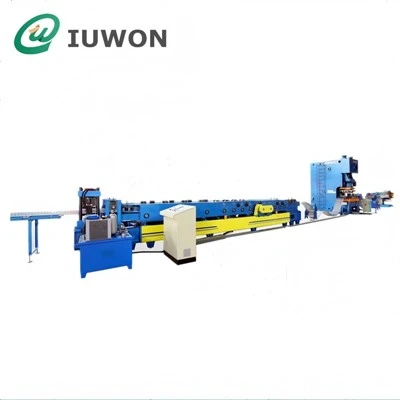
Hey guys, thanks for stopping by. If you’re in the highway safety or metal fabrication game, you’ve probably stared at a guardrail roll forming machine and wondered something I hear all the time: “Can this thing actually pump out two different guardrail profiles without being a whole separate machine?” As a vendor who’s been selling these bad boys for over a decade, I get why this question hits different—nobody wants to drop six figures on two machines when one might do the trick. Let me break this down straight, no fancy jargon, just what I’ve seen work (and what doesn’t) for hundreds of clients. Guardrail Roll Forming Machine
First off, let’s cut through the “different profiles” confusion. When people say “two guardrail profiles,” they’re usually talking about the two main ones out there: W-beam (that’s the standard curved one you see on most interstate roads) and Thrie-beam (the deeper, angular one used on tighter curves or high-crash areas). Sometimes they mean a third one too—like a smaller residential guardrail or a bridge rail—but 9 times out of 10, it’s W vs Thrie. So can one machine do both? Short answer: Yes… but only if it’s built right, and you don’t expect it to switch in 2 minutes flat like a microwave.
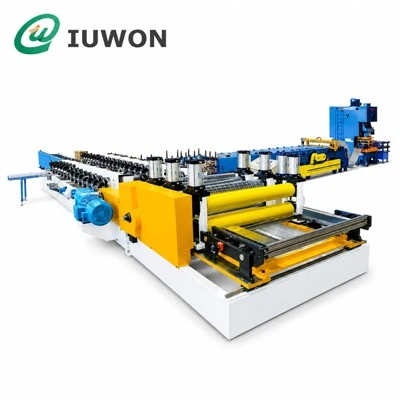
Let me explain how these machines work, because that’s where the magic (or the headache) happens. A guardrail roll forming machine is basically a long line of rollers—like dozens of round metal wheels—each set shaped to bend the flat steel coil into that specific profile. For W-beam, each roller has a curve that forms that classic W shape. For Thrie-beam, each roller is a little deeper and has a sharper angle to make that three-sided ridge. If you try to run Thrie-beam rollers for W-beam, you’ll get a guardrail that’s too wide or not curved enough, and if you flip it, W-beam rollers won’t create enough depth for Thrie.
So the key is: quick-change tooling. That’s the make-or-break feature. I’ve seen cheap knockoff machines that advertise “dual profile capability” but what they really mean is you have to unbolt every single roller one by one, carry them to a storage closet, grab the other set, and bolt them back on. That takes 8 hours minimum—sometimes a full day—if you don’t have extra hands. By the time you switch runs, you’ve wasted half a shift, and you’re probably making zero profit on that smaller job because of the downtime. The good machines, the ones we sell, have quick-change systems where you can swap entire rows of rollers in less than 20 minutes. Some even have motorized rollers that slide in and out on rails, so you don’t even need tools. I had a client in Ohio last year who switched from W-beam to Thrie-beam at 8 a.m. and was running new stock by 8:15—saved him so much time he picked up an extra contract just because he could turn jobs around faster.
But wait, there are limits. You can’t just make W-beam and a random custom profile. We recently had a guy reach out saying he wanted to run W-beam and a 4-inch round pipe “guardrail”—that’s not a guardrail, that’s a pipe. The DOT won’t approve it, and it won’t pass crash tests. The two profiles have to be industry-standard, tested and approved, because guardrails aren’t just metal—they’re safety equipment. So if you’re sticking to AASHTO (that’s the American Association of State Highway and Transportation Officials, the folks who set the rules for all US highways) approved W-beam and Thrie-beam, the quick-change machine works. If you’re trying to do something way off-spec, you’re wasting your money.
Another thing to consider: material width and thickness. Most guardrail is made from 12-gauge or 10-gauge steel, 12 inches wide for W-beam, 19 inches for Thrie-beam? Wait, no, let me get that right—W-beam is typically 12.5 inches wide when flattened, Thrie is about 19 inches. If your machine is set for W-beam, can it handle the wider Thrie steel? You might need to adjust the side guides, which is another quick step, but still doable if the machine’s built with that adjustment in mind. I’ve seen clients skip this and try to force a wider coil through a W-beam machine, which bends the rollers and ruins a $1,000 steel coil. Don’t do that.
Now, let’s talk about why this matters for you, the owner or operator. If you’re a small fab shop that does both local road jobs and occasional bridge projects, a dual-profile machine means you don’t have to tie up cash in two separate machines. A new W-beam machine is around $50k, Thrie is another $50k—total $100k. A quick-change dual-profile machine is around $75k. That’s $25k in your pocket that you can use for inventory, or hiring another worker, or upgrading your truck fleet. Bigger guys, like highway contractors who need to keep multiple jobs running at once, love this too—if one job needs W-beam today and Thrie tomorrow, they don’t have to rent space for a second machine.
But I should also mention the downsides, because I’m not here to sell you something you’ll regret. First, upfront cost is higher than a single-profile machine. If you only ever run W-beam, don’t waste the cash on dual-profile—just get the single one, it’s cheaper and more durable because it’s not designed to swap parts. Second, maintenance. Swapping rollers means more moving parts, more things that can wear out. You have to keep track of the roller sets—if you lose a W-beam roller, you can’t run Thrie, and vice versa. We give all our clients lockable storage carts for the extra rollers, so that’s a non-issue, but you have to use them. Third, speed. When you’re running W-beam, a single-profile machine might crank out 60 feet per minute, while a dual-profile might do 50—nothing crazy, but over a 10,000-foot run, that’s an hour difference. Not a big deal for most, but if you’re in a huge rush, single-profile is faster.
I’ve seen so many clients make the mistake of buying a cheap dual-profile machine from a no-name company on Alibaba, just because it’s $20k cheaper. Then they call us a few months later, panicking, because the rollers don’t line up, the switch takes 3 hours, and they can’t get parts when something breaks. Last year, a guy from Texas bought one of those, and within 6 months, half the rollers were bent, and the motor for the quick-change broke. The seller disappeared, and he had to pay us to fix it, plus he lost a $200k contract because he couldn’t deliver on time. That’s the stuff I warn people about.
So let’s circle back to the original question: Can a guardrail roll forming machine produce two different guardrail profiles? The answer is a resounding yes—if it’s a quality machine with a proper quick-change system, built for industry-standard profiles. It’s not a magic trick, it’s just smart engineering that lets you adapt without buying two separate machines.
Now, if you’re out there shopping for a machine, don’t just ask “can it do two profiles?” Ask how long the switch takes. Ask about the roller quick-change system—are they manual or motorized? Does it come with extra rollers? What kind of warranty is there? I tell every client: if a vendor can’t give you straight answers on that, walk away. We walk you through every part of the machine, show you a live demo of switching profiles, and even send you videos of our current clients using the machines day-to-day so you can see it works.
At the end of the day, the whole point is to save you time and money, not give you another headache. If you’re tired of juggling two machines, or losing jobs because you can’t turn different profiles around fast enough, a good dual-profile machine is worth every penny. But if you’re only ever running one type, save the cash and go single.
If you’re ready to stop guessing and figure out what machine fits your needs, hit us up. We don’t do pushy sales calls—we’ll listen to what you’re actually working on, show you what works, and even help you calculate if a dual-profile machine makes sense for your bottom line. No pressure, just real advice from someone who’s been in this game for years, watching clients win and lose because of these machines.
Profile Roll Forming Machine REFERENCES
- American Association of State Highway and Transportation Officials (AASHTO). (2021). Standard Specications for Highway Guards. Washington, DC: AASHTO.
- Roll Forming Technology for Metal Construction. (2022). “Quick-Change Systems for Multi-Profile Guardrail Machines.” Industrial Fabrication Journal, Vol. 18, No. 3, pp. 45-52.
- Federal Highway Administration (FHWA). (2020). Guardrail Crash Test Performance Standards. Washington, DC: U.S. Department of Transportation.
Hanghzou IUWON Technology Co., Ltd.
Hangzhou IUWON Technology Co., Ltd. is one of the most professional guardrail roll forming machine manufacturers and suppliers in China. Please feel free to buy custom made guardrail roll forming machine made in China here from our factory. For price consultation, contact us.
Address: No.755, Xintangtou Village, Xinjie Street, Xiaoshan District, Hangzhou, Zhejiang
E-mail: sales@iuwon.com
WebSite: https://www.iuwonforming.com/
